

The Golden Rule of Trade
Who pays for ocean carriage and who carries the physical transit risk are two separate legal determinations. Cost and risk do not travel together.
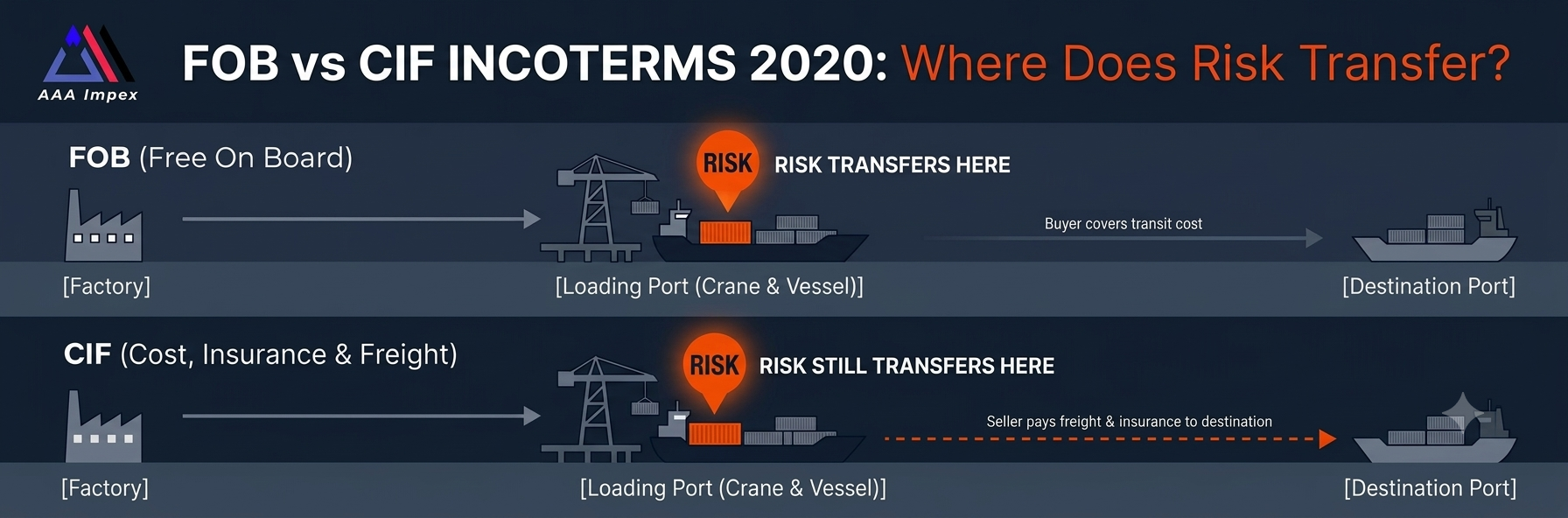
When structuring international shipping agreements, comparing FOB vs CIF is one of the most critical decisions a new exporter can make. Consider a standard export scenario: a manufacturer ships commercial cargo from Nhava Sheva (JNPT) or Mundra Port to a customer in Rotterdam under CIF terms. The exporter contracts the freight forwarder, prepays ocean transit, and procures a marine cargo insurance policy naming the destination port.
Three days into the voyage, the vessel encounters severe weather in the Arabian Sea, washing multiple container stacks overboard.
When disaster strikes, many first-time exporters assume: “We paid the freight and insurance all the way to destination. Therefore, the cargo loss is our problem.”
Under international commercial law, that assumption is incorrect. Under the ICC Incoterms® 2020 rules, physical transit risk belongs legally and commercially to the overseas buyer the moment goods are loaded on board the vessel at the origin port.
Understanding FOB vs CIF: How FOB (Free On Board) Functions
- ➜ Seller Scope (Exporter): Delivers cargo to the designated domestic sea port (e.g., FOB Nhava Sheva), handles export customs clearance and ICEGATE Shipping Bill filing, and pays origin Terminal Handling Charges (THC) up to vessel loading.
- ➜ The Point of Risk Transfer: Risk transfers to the overseas buyer the exact moment cargo is loaded on board the vessel nominated by the buyer.
- ➜ Buyer Scope (Importer): Nominates the shipping line, pays main ocean freight (Freight Collect), procures marine cargo insurance if desired, and clears destination import customs.
FOB vs CIF: The Two-Port Paradox in CIF Contracts
In evaluating FOB vs CIF (Cost, Insurance, and Freight), commercial teams frequently mistake invoiced carriage costs for transit liability. The Incoterms® 2020 rules structure CIF around two distinct geographic ports:
- ➜ Port of Loading (Where Risk Flips): The origin port of shipment. Just like FOB, physical risk transfers to the buyer once the cargo is loaded on board the vessel.
- ➜ Port of Destination (Where Costs End): The overseas port of discharge (e.g., CIF Rotterdam), up to which the seller prepays ocean freight and mandatory minimum marine insurance.
- ➜ The Endorsed Marine Insurance Policy: The exporter procures insurance for the benefit of the overseas buyer. If the vessel is lost mid-transit, the buyer files the claim directly against the underwriter using the endorsed insurance certificate and Bill of Lading (BL).
FOB vs CIF Comparison Table: Costs, Risks & Responsibilities
| Trade Dimension | FOB (Free On Board) | CIF (Cost, Insurance & Freight) |
|---|---|---|
| Transport Mode | Sea & Inland Waterway Only | Sea & Inland Waterway Only |
| Point of Risk Transfer | Origin Port (Loaded on board) | Origin Port (Loaded on board) |
| Export Customs & Shipping Bill | Seller (Exporter) | Seller (Exporter) |
| Origin Port Handling (THC) | Seller (Exporter) | Seller (Exporter) |
| Main Ocean Freight | Buyer (Freight Collect) | Seller (Freight Prepaid to Destination Port) |
| Marine Cargo Insurance | Not Mandatory (Buyer’s Option) | Mandatory on Seller (Min. ICC Clause C) |
| Destination Unloading & Import Duty | Buyer (Importer) | Buyer (Importer) |
Pre-Shipment Compliance Check
Filing a Shipping Bill under FOB or CIF? Verify your 8-digit ITC-HS code and RoDTEP eligibility first.
4 Critical Mistakes New Exporters Make When Quoting FOB vs CIF
When deciding between FOB vs CIF for your first export order, theoretical definitions are only half the battle. From our New Delhi customs desk, these are the four operational traps that catch first-time exporters off guard:
- ➜ 1. Miscalculating Export Incentives (RoDTEP & Duty Drawback) on CIF Invoices: Even if you invoice your overseas buyer on CIF terms, Indian Customs calculates export incentives like RoDTEP and Duty Drawback strictly on the FOB value—not the CIF value. Always separate your product value, ocean freight, and insurance clearly on the Commercial Invoice and Shipping Bill after confirming your 8-digit ITC-HS classification.
- ➜ 2. Ignoring the Institute Cargo Clauses (ICC-C vs. ICC-A) Trap: Under Incoterms® 2020, CIF only requires the seller to purchase minimum marine insurance under Institute Cargo Clauses (C)—which covers major catastrophes (sinking, fire, collision) but excludes theft, pilferage, and moisture damage. If your buyer expects “All Risk” protection (ICC-A), price the higher premium into your CIF quote and state the clause explicitly in your Proforma Invoice.
- ➜ 3. Using FOB/CIF for Inland Container Depot (ICD) Handovers: Strictly speaking, FOB and CIF apply only to non-containerized sea freight where cargo crosses the ship’s rail. If you hand over sealed containers at an inland terminal like ICD Tughlakabad or ICD Patparganj, use FCA or CIP instead—otherwise, you carry uninsured physical risk while the container sits at the port terminal awaiting vessel loading.
- ➜ 4. Locking In CIF Quotes Without Freight Validity or Payment Milestones: Quoting CIF exposes new exporters to sudden ocean freight spikes and destination container detention if a buyer delays clearance. Protect your working capital by adding a 7-to-14-day freight validity clause on CIF quotes and tying your final balance payment against the Draft Bill of Lading (BL)—the exact milestone structure we enforce across our Exporter of Record (EoR) and FOB/CIF execution programs.
Frequently Asked Questions: FOB vs CIF
Is FOB or CIF better for a first-time exporter?
For most first-time exporters, FOB (Free On Board) is safer and simpler. Once your Customs House Agent clears the Shipping Bill and loads the cargo onto the buyer’s nominated vessel, your cost and physical risk obligations end—protecting you from ocean freight fluctuations and destination port delays.
Who pays for export customs clearance in FOB vs CIF?
In both FOB and CIF, the seller (exporter) is responsible for completing origin export customs clearance, filing the Shipping Bill on ICEGATE, obtaining the Let Export Order (LEO), and paying origin port terminal handling charges.
Does CIF include destination port charges and import duty?
No. Under CIF, the seller only pays ocean freight and minimum marine insurance up to the port of discharge. Destination Terminal Handling Charges (DTHC), import customs clearance, and import duties/taxes belong entirely to the buyer.
How are export incentives (RoDTEP/Drawback) calculated under CIF vs FOB?
Indian export incentives such as RoDTEP and Duty Drawback are always calculated on the FOB value of the goods, even when the commercial invoice is raised on CIF terms. Exporters must declare the FOB value, freight, and insurance separately on the Shipping Bill.
Need Export Customs Clearance or End-to-End FOB/CIF Execution?
From ICEGATE Shipping Bill filing and ICD clearance to factory-gate AQL 2.5 inspection under one Bill of Lading, our New Delhi trade desk protects your shipment from origin to port.